CrashCount working briefing · Phase 1
What NYC Knows About Safer Trucks
The City has already studied safer truck design and technology. This is a public notebook of what it found, which fleets are covered, and what we still need to learn.
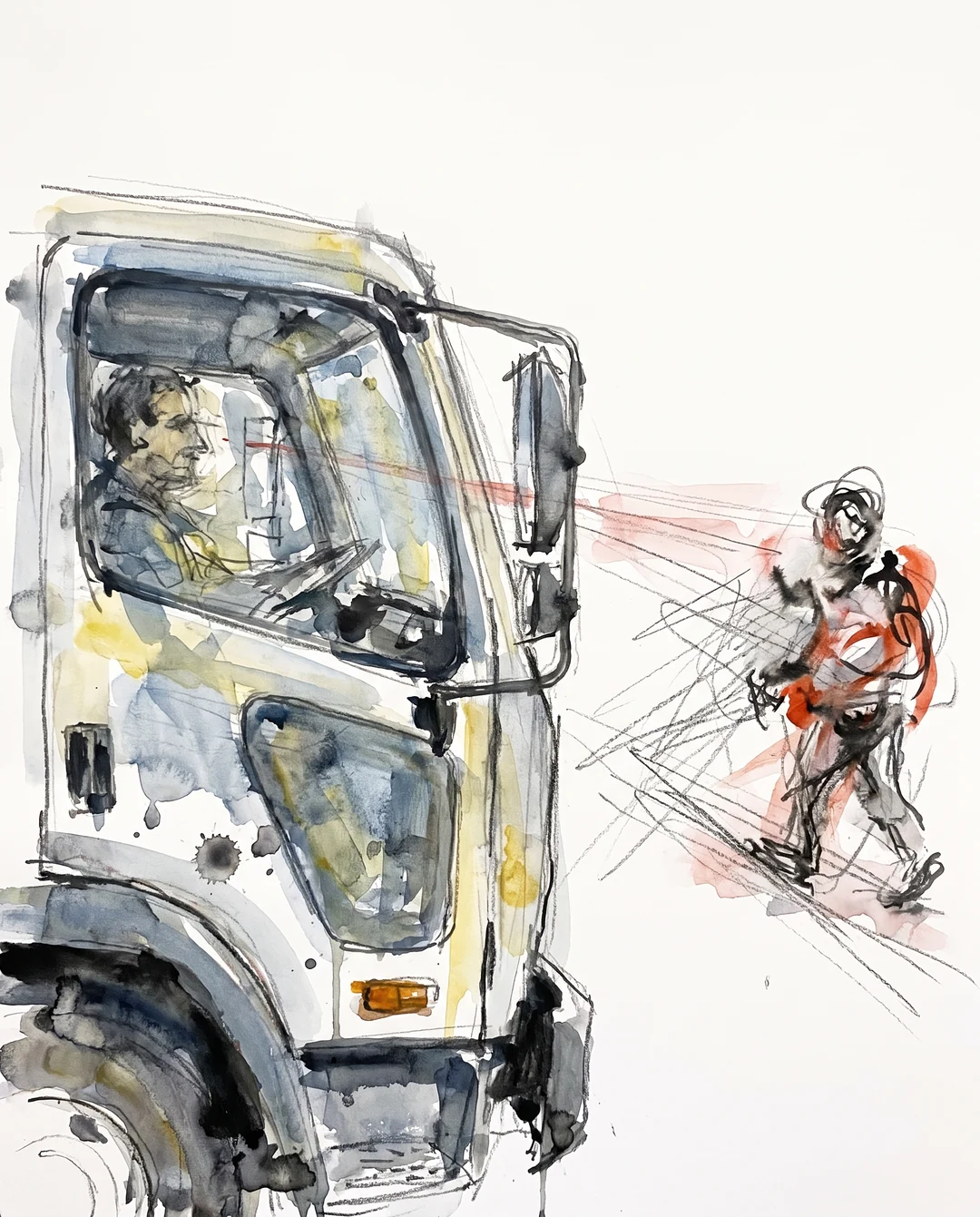
Direct vision is one of several measures the City studied.
The short version
New York City has already spent years studying how truck design and safety technology can protect people walking and biking. It has begun applying that work to vehicles the City owns and to some vehicles used under large City contracts.
Those findings now reach some City-owned, City-contracted, and regulated trade-waste trucks. Many private trucks operating on New York City streets fall outside those programs.
The City-regulated trade-waste fleet—including companies that haul construction and demolition debris—is one practical place to ask what should come next. Gaps in City-contractor rules and the larger private fleet deserve examination too. This briefing does not yet choose one bill or one technology.
This briefing collects what is already known, what CrashCount can add, and where help is needed. The core proposition is simple:
New York City has already identified a menu of safer truck designs and technologies. The open question is how to carry that work into more of the trucks operating on city streets.
Browse CrashCount’s large-truck crash index for the underlying deaths and serious injuries. It is a separate, source-linked record of the cases; this briefing explains the policy and research questions around them.
Why this work started
Carolyn Cox
On June 26, 2024, 83-year-old Carolyn Cox was killed near her home at Bond and Butler Streets in Brooklyn. Police said the driver of a dump truck was turning right when the truck struck her; published photographs show a conventional-cab truck. The investigation and reporting do not establish that a particular safety technology would have prevented her death.
Her death raises the question at the center of this project: what happens after a city identifies safer designs and technologies, but they do not reach many of the trucks operating on its streets?
- CrashCount fatality page for Carolyn Cox
- Brooklyn Eagle report on Carolyn Cox
- NYPD collision record on NYC Open Data
Maria Piovanetti
On March 7, 2024, 58-year-old Maria Piovanetti was killed at Bedford and Tilden Avenues in Brooklyn. Reporting connected the dump truck to a nearby construction site and said the same physical truck, with a different driver, had struck and killed a crossing guard in Queens several months earlier. Video described in the reporting showed the truck slow or stop before turning through the crosswalk.
- CrashCount fatality page for Maria Piovanetti
- News 12 report and construction-site account
- CBS New York report
These cases are not proof that all dump trucks, construction companies, or drivers present the same risk. They are reasons to examine whether known safety improvements have reached the fleets operating around New Yorkers.
What the City already found
2017: the Safe Fleet Transition Plan
The City asked the U.S. Department of Transportation’s Volpe Center to identify safety technologies for the municipal fleet. The resulting plan organized equipment and design changes into required, best-practice, and exploratory tiers. It included side guards, improved visibility, cameras, lighting, telematics, collision warnings, automatic braking, and high-vision cabs.
Read the 2017 Safe Fleet Transition Plan
2021: private trade-waste crashes
The City and Volpe then examined 43 reported fatal crashes involving BIC-regulated vehicles from 2010 through May 31, 2019.
The study found:
- At least 10 start-from-stop visibility-related fatal crashes.
- All 10 involved conventional cabs; none involved cabover trucks.
- The ranked screening identified safety lights, high-vision truck cabs, and pedestrian automatic emergency braking as the three technologies potentially relevant to the largest number of reviewed fatal crashes.
- Among retrofit technologies, safety lights, pedestrian warnings, surround cameras, and additional mirrors ranked highest.
- The study’s conclusion described surround cameras, safety lights, and pedestrian automatic emergency braking as especially promising for trade-waste vehicles.
The authors warned that this was a small, incomplete dataset. The ranking measured potential relevance, not proven effectiveness. Vehicle mileage, equipment status, and other possible confounders were missing. It should guide action and further evaluation, not be presented as proof that one device would have prevented one death.
Read the 2021 private-fleet study
2025: the City keeps moving
The City’s 2025 update reports more than 100,000 fleet safety improvements since 2017. It says more than 2,000 City trucks qualify as high-vision or use surround cameras, with hundreds more cameras ordered. It also describes turning alerts, automatic braking, backup sensors, telematics, and intelligent speed assistance.
What safer trucks can include
The City reports do not point to one silver bullet. They examine layers of design and technology that address different kinds of risk. These illustrations are interpretive—not engineering diagrams—and were created with Gemini using CrashCount’s original paintings as style references.
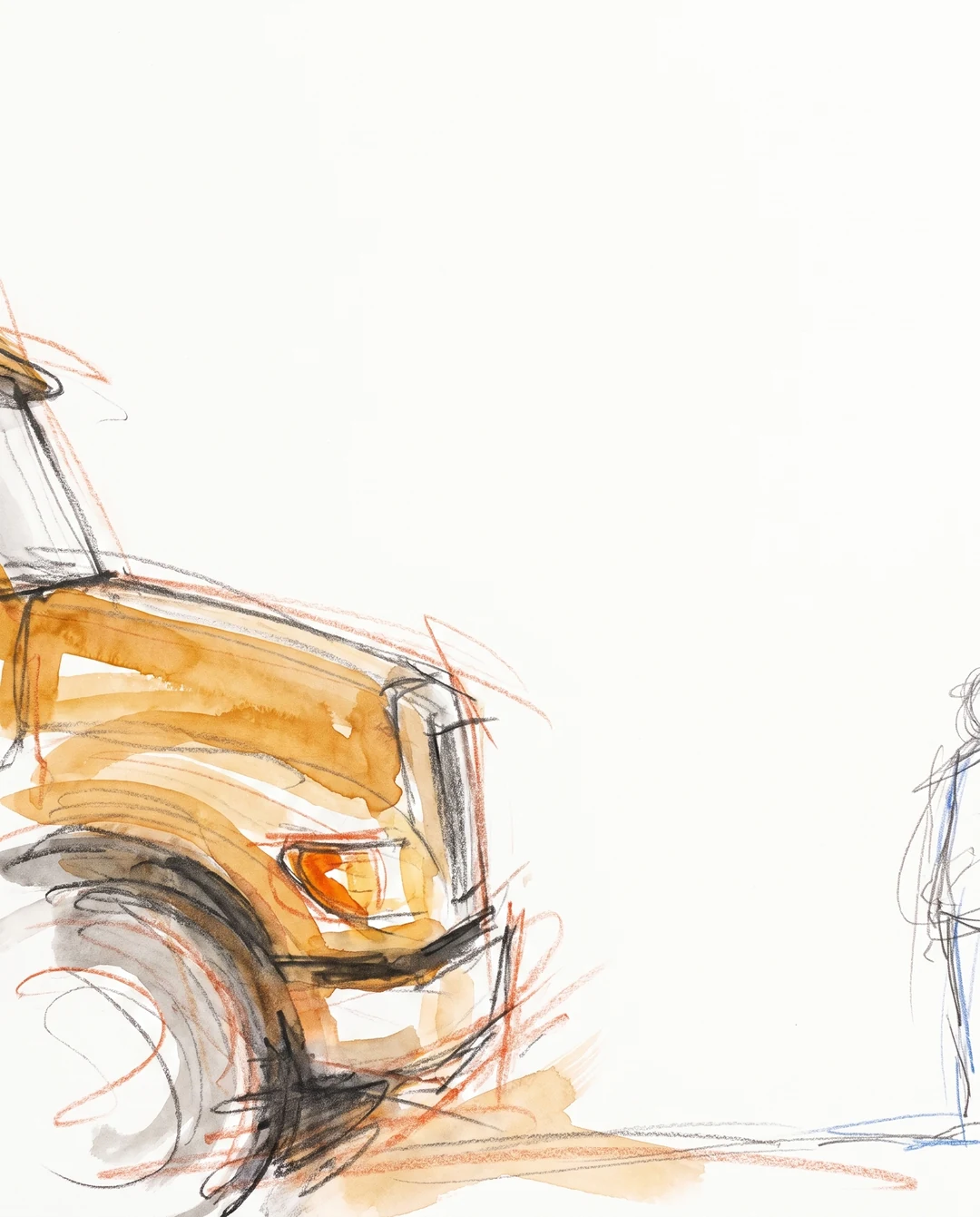
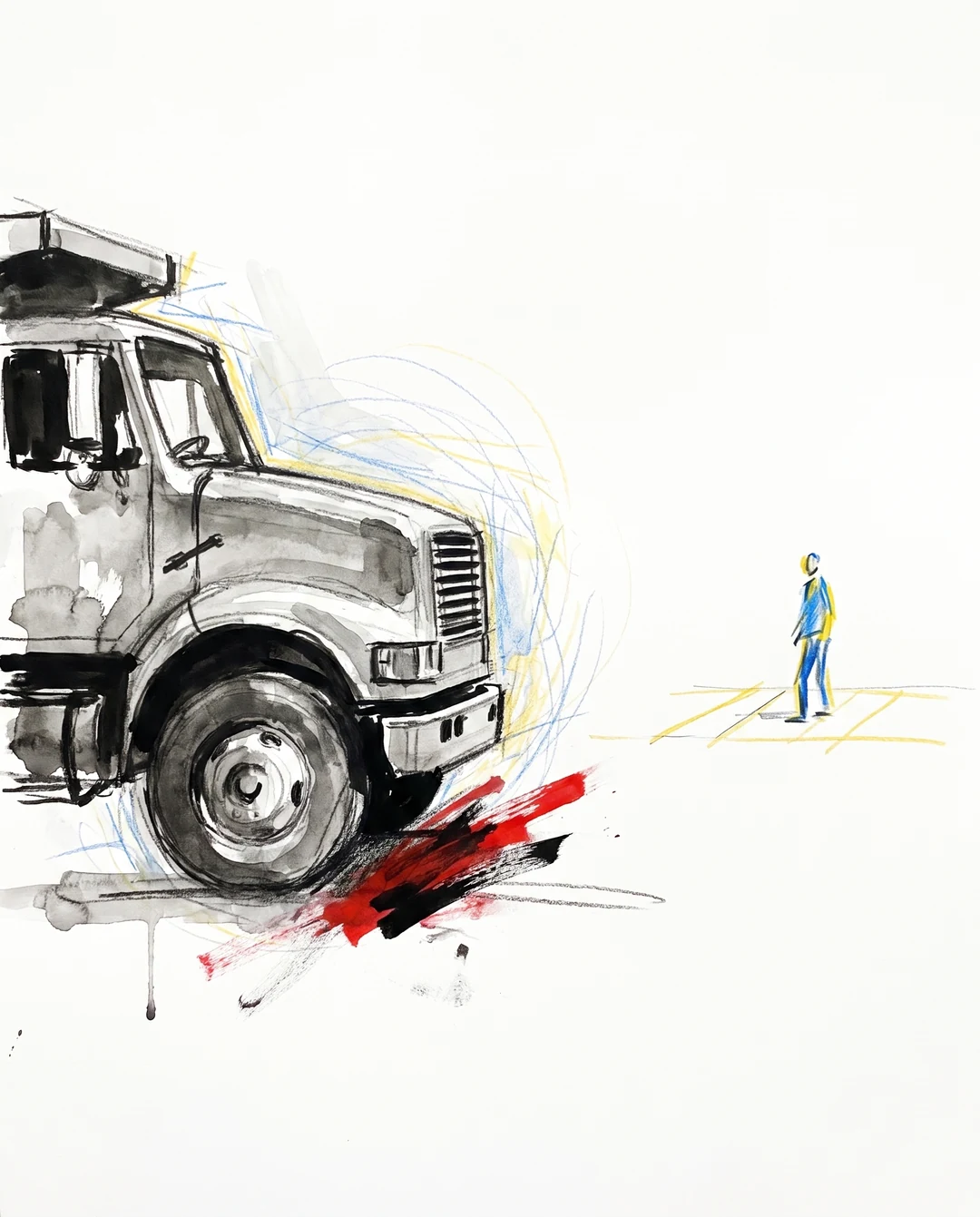
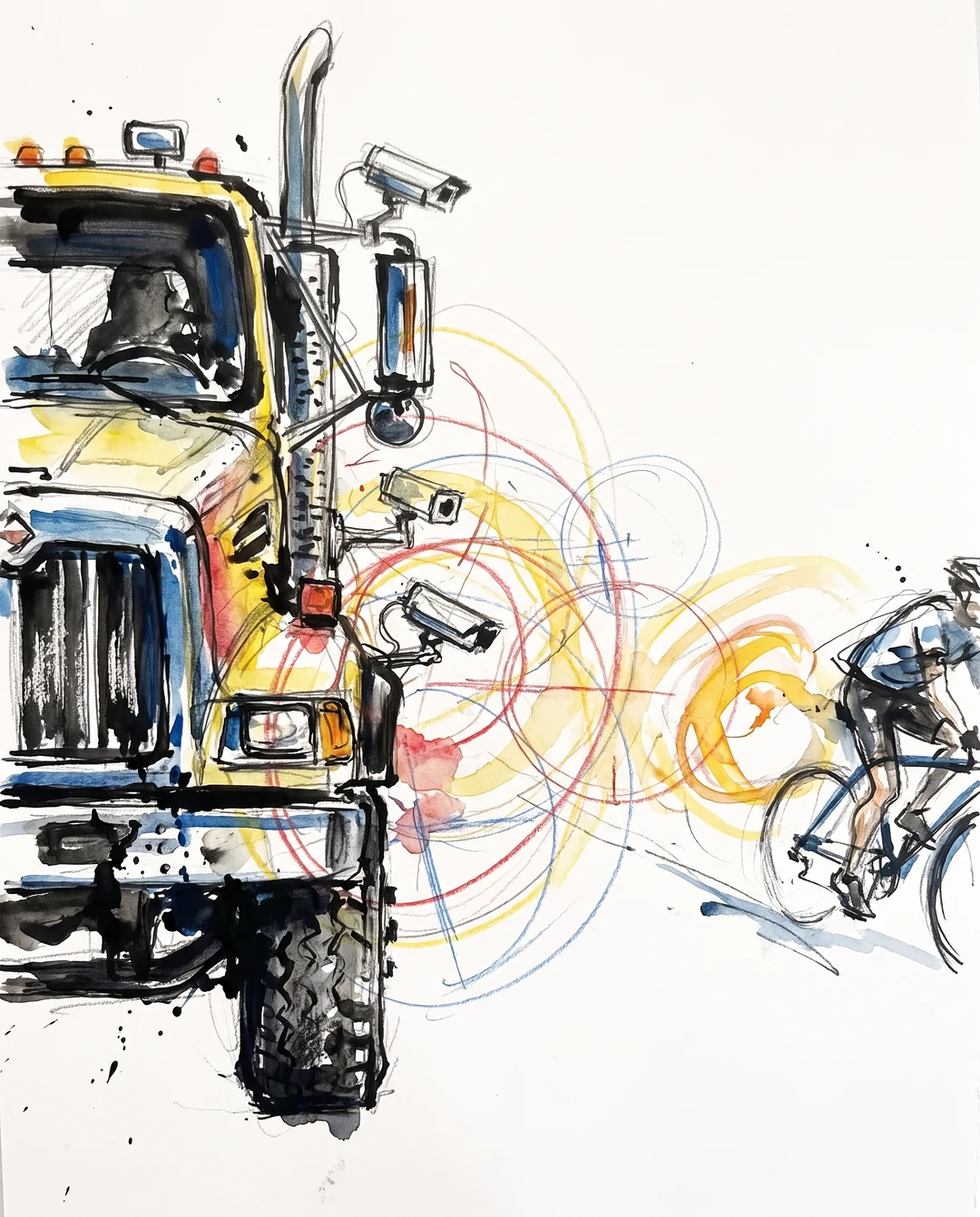
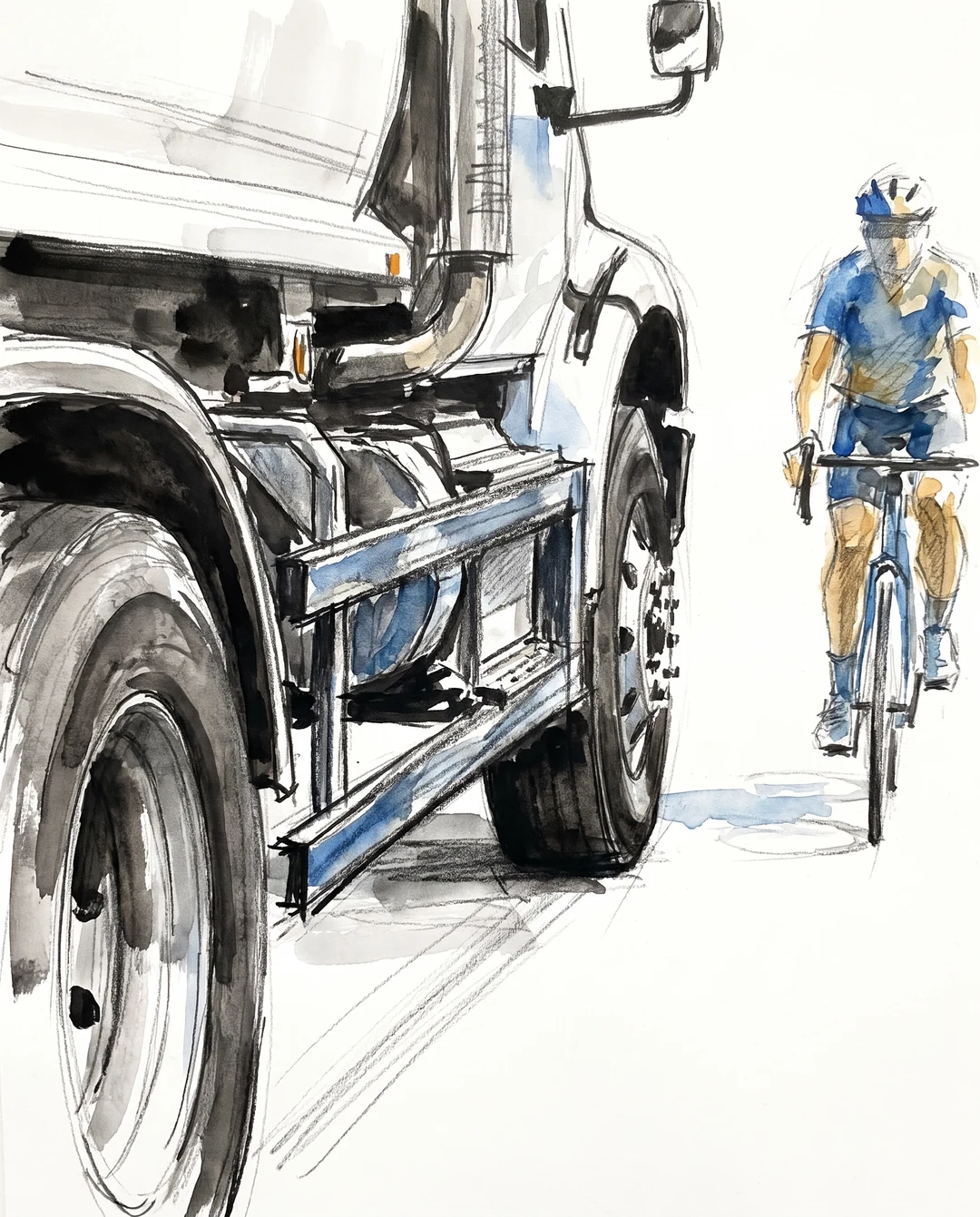
The 2021 report ranked technologies by how often they appeared potentially relevant to the crashes it reviewed. It did not measure the real-world effectiveness of every technology, establish that a device would have prevented a particular crash, or prescribe a single package for every truck.
Who is covered now—and who is not
| Fleet | What currently applies | Important limits or open questions |
|---|---|---|
| City-owned fleet | The City’s fleet plan covers procurement, side guards, cameras or high-vision designs, telematics, training, and other technologies. | Requirements vary by vehicle type and technology availability; exemptions and implementation data need review. |
| Some City contractors | Executive Order 39 requires safety plans, driver monitoring, telematics, crash reporting, and surround cameras unless a truck meets the high-vision standard. Local Law 108 requires side guards in covered contracts. | Generally limited to vehicles used weekly or more under mayoral-agency contracts worth at least $2 million. Older contracts, certain solicitations, emergency work, utilities, and other categories may be excluded. Exemptions are available. |
| BIC-regulated trade-waste fleets | Side guards, crossover mirrors on covered conventional cabs, inspections, training, reporting, and other safety rules. Commercial-waste-zone rules add further requirements for covered collection vehicles. | Construction-and-demolition haulers outside commercial waste zones remain under BIC rules, but there is no comprehensive high-vision or surround-camera transition comparable to Executive Order 39. |
| Other private trucks | Federal and State vehicle standards, New York traffic law, and generally applicable City traffic rules. | Many construction, delivery, and freight trucks are neither City contractors nor BIC-regulated waste vehicles. A broad local equipment mandate may require State authority and federal preemption review. |
Important terminology
- City contractor does not mean every contractor operating in the city.
- BIC-regulated construction-and-demolition hauler does not mean every construction truck.
- Truck-involved crash means a truck was recorded in the crash. It does not by itself establish fault, ownership, or the work the truck was performing.
- In the City’s contractor rule, a high-vision truck has a cab-over or cab-forward design with the driver seated in front of the front axle. It is a vehicle design category, not simply the presence of a camera.
What the Council has already tried
Truck safety is not a new legislative subject at City Hall. A review of the official Council record from 2014 through August 17, 2026 found a useful lineage:
- Int. 198-2014 became Local Law 56 of 2015. It created the side-guard requirement for heavy City-fleet and BIC-licensed or registered trade-waste vehicles.
- Int. 1789-2019 became Local Law 108 of 2021. It accelerated the City/BIC deadline and extended side guards to trucks used regularly under covered City contracts worth at least $2 million.
- Int. 2182-2020 did not pass. It would have required parking sensors on heavy City and covered City-contractor vehicles. The proposal addressed close-range obstacles while parking or reversing; it was not a surround-camera, pedestrian-braking, or direct-vision mandate.
- Resolution 1261-2016 did not pass. It called on Albany to require transparent panels in the lower portion of truck doors—the clearest prior Council proposal aimed at direct vision.
- Int. 1354-2019 became Local Law 71 of 2020. It requires chute-closure devices on concrete mixer trucks driven in the city. Though it addresses concrete spillage rather than crash avoidance, it is a precedent for directly requiring equipment on a private construction-truck class.
- Int. 1573-2019 became Local Law 198 of 2019. It expanded BIC’s health-and-safety enforcement authority, including license consequences for public-safety violations. It did not itself mandate truck equipment.
The current Council has bills concerning warehouse truck routes, truck-route enforcement training, and construction-waste plans. None requires the safety measures examined in the 2021 Volpe report.
We found no filed Council introduction from 2014 through August 17, 2026 that requires high- or direct-vision cabs, surround cameras, pedestrian-detecting automatic braking, or turn-warning lighting on private, BIC-regulated, or construction-and-demolition fleets. This was a systematic search of titles and official records, not proof that no unfiled draft or agency proposal exists. The City’s own Vision Zero scorecard still lists BIC’s effort to pursue high-visibility-cab legislation as “In progress.”
Preliminary CrashCount screen
CrashCount performed an initial development-data screen of police-reported crashes from January 1, 2022 forward. It counted distinct crashes containing a police vehicle record normalized as a truck and excluded records identified as pickups.
| Geography | Truck-involved crashes | People killed | Serious-injury crashes | People injured |
|---|---|---|---|---|
| New York City | 29,689 | 148 | 692 | 13,546 |
| Council District 33 | 1,683 | 5 | 24 | 560 |
| Council District 38 | 885 | 7 | 25 | 412 |
| Council District 39 | 882 | 3 | 12 | 302 |
These figures are research leads, not campaign statistics yet. They include box trucks, tractor trucks, dump trucks, refuse trucks, tow trucks, tankers, concrete mixers, and other police-recorded truck types. They do not identify City ownership, BIC status, contractor status, fault, cab design, cameras, braking technology, or side guards. Current NYPD data also contains a publication delay; CrashCount’s source page documents the latest available record date.
- CrashCount data methods and current source status
- NYPD crash table
- NYPD person table
- NYPD vehicle table
What CrashCount can add next
The existing CrashCount system can calculate:
- Truck-involved crashes, injuries, serious injuries, and deaths by Council district.
- Pedestrian and cyclist harm.
- Truck subtype breakdowns.
- Turning, backing, impact point, lighting condition, and police-coded contributing factors.
- Crashes on and off designated truck routes.
- Truck-route mileage and severe harm per route mile.
- Streets and intersections with repeated severe truck crashes.
- Named fatal cases with reviewed press coverage.
The central missing field is who operated the truck and what work it was performing. Police crash data does not provide the company, agency, contract, permit, BIC status, or safety equipment.
The smallest reliable next step is a reviewed ledger for fatal and serious-injury cases. Each classification should cite documentary evidence and allow “unknown”:
- City-owned
- City-contracted
- BIC-regulated trade waste or construction-and-demolition
- Other documented private operation
- Unknown
Active construction permits, vehicle type, and nearby work sites can identify research leads. They cannot prove that a particular truck belonged to a project.
Questions this research opens
These are possible lines of inquiry for early conversations, not a finished CrashCount platform.
1. What should follow the BIC study?
Ask the City, operators, advocates, and safety experts which measures from the 2021 study are practical and enforceable for BIC-regulated trade-waste vehicles, including construction-and-demolition registrants. Public fleet, equipment, inspection, crash, and waiver data would make that discussion more concrete.
2. Where do City-contractor rules stop?
Examine the $2 million threshold, grandfathering, excluded contract categories, replacement vehicles, exemptions, and public reporting in Local Law 108 and Executive Order 39. Determine which changes can be codified by the Council.
3. What would reach the remaining private fleet?
Determine which actions are within City authority and which require Albany. Pending State bills S3391 and A2351 offer one starting point on side underride guards, though their current scope is limited.
Before any proposal is finalized, Council legislative counsel should review State-law authority and federal vehicle-safety preemption.
Early Council conversations
These are signals for an opening conversation, not claims that any member has endorsed a particular contractor-truck bill.
- Shahana Hanif, District 39: In a 2022 Streetsblog essay, Hanif wrote that planning streets for people means designs that slow drivers and listed daylighting, pedestrian head starts, and safety islands. Her Council office calls ending traffic injuries and deaths a core priority and describes work on daylighting and safer bike lanes. That is clear general street-safety evidence; it is not, by itself, a position on private-truck equipment or contractor rules.
- Alexa Avilés, District 38: Avilés was the prime sponsor of Local Law 171 of 2023, the enacted truck-route-network redesign law. Its Council record says the redesign is to improve safety and visibility and requires DOT to assess daylighting or daylighting barriers at truck-route intersections. This is directly truck-related legislative work, though it does not show support for every possible fleet-safety requirement.
- Lincoln Restler, District 33: Restler co-sponsored Local Law 171 of 2023; his Council biography identifies safer streets and corridor-safety work as priorities. The Council’s current member record lists him as chair of the Committee on Contracts. That makes him relevant to questions about City-contractor coverage and reporting, not a documented supporter of a specific mandate.
- Shaun Abreu: chair of Transportation and Infrastructure.
- Justin Sanchez: chair of Sanitation and Solid Waste Management.
An initial meeting should ask for help testing the problem definition, identifying legal authority, obtaining agency data, and finding the right legislative home—not merely request a signature on finished language.
How you can help
This project is at the stage where informed criticism is more useful than endorsement.
Policy and legal review
Help distinguish what the Council can require directly, what BIC or DSNY could do by rule, and what needs Albany.
Case verification
Help document fatal and serious crashes, truck operators, work context, cab design, and available safety-equipment evidence.
Industry knowledge
Explain vehicle replacement cycles, product availability, maintenance, driver workflow, false-alert risks, and realistic implementation schedules.
Coalition building
Introduce organizations representing victims, street-safety advocates, environmental-justice communities, workers, responsible fleet operators, construction stakeholders, and vehicle-safety experts.
Storytelling and design
Help turn technical distinctions into accurate public language, diagrams, short video, and district-specific materials without claiming more than the evidence supports.
Have a source, correction, case, or perspective we should include? Email hello@crashcount.nyc.
Questions for early readers
- Is the BIC-regulated fleet the right first place to test what should follow the City’s study?
- Which combination of the studied measures is meaningful, available, and realistically enforceable?
- What operator, vehicle, inspection, and crash data already exists but is not public?
- Who should be in the first room before legislation is drafted?
- What would make this briefing useful to a Council office, victim’s family, fleet operator, or advocate?
Source library
City research and fleet policy
- 2017 Safe Fleet Transition Plan
- 2018–2019 Safe Fleet Transition Plan update
- 2021 Safe Fleet Transition Plan: Private Vehicle Crashes and Safety Technology
- 2025 Safe Fleet Transition Plan update
- DCAS Vision Zero and the City fleet
- NYC Vision Zero initiative scorecard
- Comptroller: Wreckless Spending
City contractors
BIC, trade waste, and construction-and-demolition hauling
- Business Integrity Commission
- BIC side-guard requirements
- BIC traffic and vehicle-safety rules
- BIC safety resources and compliance materials
- BIC-approved trade-waste companies
- BIC description of construction-and-demolition registration
- DSNY commercial-waste-zone safety requirements
Truck rules and wider authority
- NYC DOT trucks and commercial vehicles
- New York Vehicle and Traffic Law § 1600
- New York Vehicle and Traffic Law § 1642
- New York Vehicle and Traffic Law § 375
- New York Senate Bill S3391
- New York Assembly Bill A2351
- Federal motor-vehicle safety preemption, 49 U.S.C. § 30103
- NHTSA proposed heavy-vehicle automatic emergency braking rule
Council and truck-route work
- Int. 198-2014 / Local Law 56 of 2015: City and BIC side guards
- Int. 1789-2019 / Local Law 108 of 2021: City-contractor side guards
- Int. 2182-2020: proposed City and contractor parking sensors
- Resolution 1261-2016: proposed lower-door direct-vision panels
- Int. 1354-2019 / Local Law 71 of 2020: concrete mixer chute closures
- Int. 1573-2019 / Local Law 198 of 2019: BIC safety authority
- Local Law 60 of 2015: truck-route crash and safety-technology study
- Local Law 171 of 2023: redesigning the truck-route network
- Int. 111-2026: warehouse truck-route study
- 2026 commercial-vehicle and truck-route enforcement bill
- Int. 899-2026: construction-waste plans
- Council District 33
- Council District 38
- Council District 39
This briefing is maintained by CrashCount, an independent record of traffic violence in New York City. Corrections, missing sources, and disagreements about scope are welcome.